By Harish Malhi, founder of Goodspeed · Updated 2 October 2026
Quick answer: hire a Framer freelancer for a small, well-defined site with no hard deadline. Hire an agency when the site carries a raise, a launch, a press cycle or a migration. Hire in-house only if you ship Framer changes every week. Freelancers charge $20 to $150 an hour, and specialist Framer agencies typically start around $10,000.
I run a Framer agency, so you'd expect me to tell you to hire an agency. Sometimes I tell people the opposite.
On one call, after hearing what a founder actually needed, I said: "It sounds like actually, you'd be better off hiring a freelancer from Upwork and building alongside them." It was a small site, the founder was hands-on, and nothing big depended on the date. A freelancer was the right call, and paying an agency would have been a waste.
This guide is how I make that call. If one person being ill would move your launch, you've outgrown a freelancer. Below that line, a good freelancer is often the better deal.
TL;DR
A good Framer freelancer is the right call for a small, well-defined site: a landing page, a portfolio, or a 5 to 10 page site with a clear brief. You pay less and work directly with the person doing the work.
An agency is the right call when the site has to carry the company through a moment: a raise, a launch, a press cycle or a migration. It also suits work that has to keep going after launch without depending on one person.
In-house makes sense only when you ship Framer changes every week and can wait for a hire.
Framer freelancers typically charge $20 to $150 an hour. Standard sites cost $1,500 to $5,000, and custom CMS builds $5,000 to $15,000, according to Contra's 2026 hiring guide. Specialist Framer agencies typically start around $10,000.
The biggest freelancer risk is continuity. One person means one point of failure.
What's the difference between a Framer freelancer, an agency and an in-house developer?
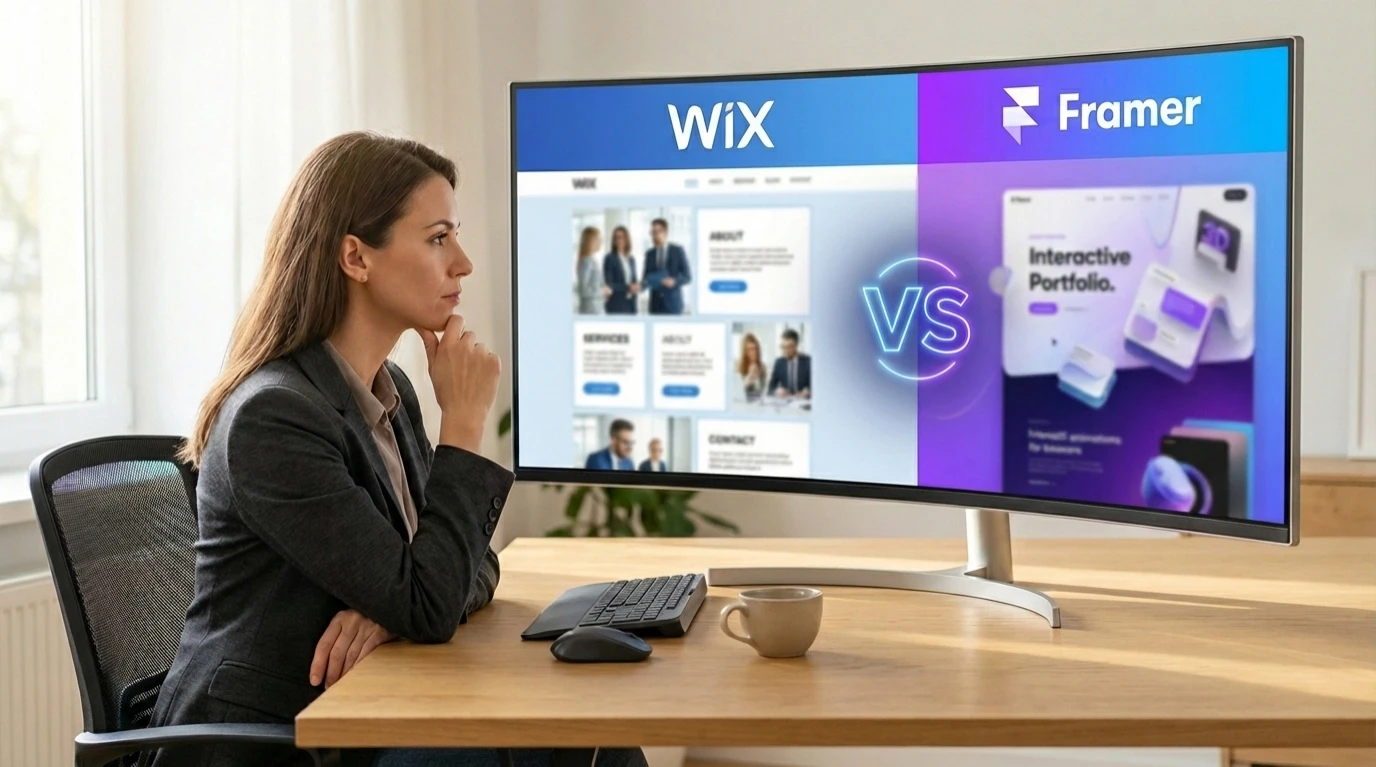
A Framer freelancer is one person who designs or builds your site, or both. An agency is a team covering strategy, design, build, SEO and project management, with more than one person who knows your site. An in-house developer is a salaried hire. All three can do excellent work. What differs is cover, speed of hiring and cost.
Think of it as a private chef versus a restaurant kitchen. A private chef can cook you a brilliant dinner for less, and you talk to the person holding the pan. A kitchen costs more, but if the chef is off sick on the night of the big party, someone else still plates the food.
Freelancers and agencies both appear in Framer's official directory at framer.com/experts, where listings show starting budgets from $1K to $50K. Framer's partner tiers (Expert, Pro Expert, Enterprise) reflect sites published and plans referred. They don't measure team size, process or SEO, so check those yourself.
Framer's own plan fees sit on top of any build cost. Framer pricing explained covers what you'll pay Framer each month. If you'd rather build it yourself, start with how to learn Framer and our honest Framer review.

Work with us
Plan a website that fits your business
Discuss your audience, content and website goals with Goodspeed before choosing your next step.

How much does it cost to hire a Framer developer in 2026?
Entry-level Framer freelancers charge $20 to $40 an hour, experienced ones $50 to $100, and premium ones $100 to $150, according to Contra's 2026 hiring guide. A standard freelancer site costs $1,500 to $5,000. Specialist Framer agencies typically start around $10,000 for a full site. An in-house developer means a full-time salary plus recruiting time.
Option | Typical rate | Typical project | Source |
Framer freelancer, entry | $20 to $40/hr | Template customisation, $500 to $1,500 | Contra |
Framer freelancer, experienced | $50 to $100/hr | Standard site, $1,500 to $5,000 | Contra |
Framer freelancer, premium | $100 to $150/hr | Custom animation and CMS, $5,000 to $15,000 | Contra |
Freelancer retainer | n/a | $1,000 to $3,000 a month | Contra |
Specialist Framer agency | Fixed project | Typically from $10,000 | Framer Experts listings |
Goodspeed | Fixed price, all public on /pricing | Landing Page from $2,500 · Tune-Up $5,000 · Signature Site from $10,000 (most $10,000 to $40,000) · Migration from $10,000 · Embedded Team from $2,000 a month | goodspeed.studio |
In-house developer | Full-time salary | Plus recruiting time before any work starts | n/a |
If you're weighing in-house because you want someone on the site every week, our Embedded Team from $2,000 a month is the middle option: a team in your Slack without a hire, rolling monthly with no minimum term.
Not sure which route fits your project? Send me the brief and your date. If a freelancer is the better fit, I'll tell you.
When should you hire a Framer freelancer?
Hire a freelancer when the scope is small and clear, nothing big depends on the date, someone on your team can manage the work, the budget is under $10,000, and you've seen their live Framer sites and spoken to a past client. That covers a lot of founders, and they're well served this way. Hire well and you save money.
The scope is small and clear. A landing page, a portfolio, or a 5 to 10 page site with a finished brief.
Nothing big depends on the date. If launch slips two weeks, nobody outside the team notices.
You or someone on your team can manage the work. That means writing the brief, owning the copy and checking the SEO.
Budget is under $10,000.
You've seen their live Framer work and spoken to a past client.
One Hacker News commenter put the case simply: "You can get a freelancer with a lot more experience, and still save money." For small, well-scoped projects, that's often true.
When should you hire a Framer agency?
Hire an agency when the site has a deadline someone outside the company will notice, has outgrown one person, is moving platform, or needs work every month after launch. It also fits when your marketing team is one to three people and nobody has time to project-manage a build. Any one of those is usually enough.
The site has a deadline someone outside the company will notice. A raise, a launch, a press cycle or a competitor's redesign.
The site has outgrown one person. Typical signs: 30+ pages, a CMS your team publishes into weekly, calculators, CRM routing, or regional variants.
You're migrating platform. Rankings and traffic are on the line, so you need a redirect map, metadata carried over and monitoring after launch. Our migration service covers this.
Your marketing team is one to three people, and none of them can project-manage a build.
The work continues after launch. New pages, launches and campaigns every month.
When should you hire an in-house Framer developer?
Only when you publish Framer changes every week, need someone available every day, and can wait for a hire before any work starts. For most funded startups that bar is high. A freelancer on retainer or an embedded agency team usually covers weekly work for less, without the recruiting time or the single point of failure.
Work with us
Make your website plans practical
Talk through design, CMS needs and integrations with our team to shape a clear build scope.
What are the real risks of each?
Freelancer risks are continuity, capacity, skill gaps and patchwork sites. Agency risks are cost, juniors doing work the seniors sold, and process that slows a small job down. In-house risks are recruiting time and one person holding all the knowledge. Know which risk you can live with, then hire to cover the rest.
Freelancer risks
Continuity. One person is a single point of failure. A Hacker News freelancer described their own business: "I usually come in when the web designer before me has disappeared."
Capacity. Holidays, illness and other clients all hit your timeline.
Gaps. Strong designers aren't always strong on SEO, analytics or CRM integration, and those gaps tend to surface after launch.
Patchwork. Several freelancers over time leave a site with no system.
Agency risks
Cost. You'll pay more than for a solo freelancer.
Seniority. Some agencies sell the senior team and staff the work with juniors. Ask who will actually do the work.
Process overhead. A big agency can be slow for a small job. Founder Michael Lynch wrote about a $46,000, seven-month agency redesign that disappointed him, and concluded he should have hired a freelancer. For a small site, that's often right.
Going quiet. Too many agencies speak on Monday and then go quiet for two weeks. Ask how often you'll hear from them, and in which channel.
What happens when a site outgrows freelancers?
It starts to slow the company down. Sydecar, a venture platform with $4.8B in assets under administration, raised its Series A with a website stitched together from freelance hand-offs and quick fixes. For a fintech selling to fund managers, a site lagging the product was costing trust before anyone booked a demo. We saw the same at Aurem, a UAE fintech that needed a credible Framer site live before launching a new service.
We rebuilt it as a system in Framer:
50+ pages on reusable templates;
CMS collections the marketing team publishes into themselves;
an SPV fees calculator and an ROI calculator wired into HubSpot.
The team now launches campaigns without waiting on freelancers and runs 10x more growth experiments. Sydecar's Marketing Manager put it this way: "Goodspeed felt like an extension of our team. They provided daily updates via Slack and Loom, so we always knew exactly what was happening and what was coming next."
The same pattern shows up elsewhere. We migrated Zen Educate, a Series B edtech operating in the UK and US, to Framer page by page with zero downtime. Reka, an NVIDIA-backed AI company, uses us as its entire design and dev team, and new product pages go live on the day each model is announced.
Site about to carry a raise or launch? Get my site ready →
Where do you find Framer specialists, and what kind of help should you buy?
Look in Framer's Experts directory, on Contra, through referrals from founders who have shipped Framer sites, and at specialist agencies. Then decide whether you need advice or a build: advisory work reviews and plans, implementation work designs and ships. Match the pricing model to how clear your scope is.
Work with us
Ready to move your website forward?
Bring your current site and priorities. We can help plan the design, build or migration around your team.
Where to look
Framer Experts directory (framer.com/experts): freelancers and agencies with starting budgets and partner tiers.
Contra and Upwork: fine for small, well-scoped jobs. Judge people on live Framer sites, not on mockups or ratings alone.
Referrals: ask founders and marketers whose Framer sites you admire who built them. For anything brand-defining, a referral usually beats a marketplace bid.
Specialist agencies: for multi-page sites, CMS work, migrations, or work that continues after launch.
Advisory or implementation?
Advisory: an audit, an architecture review, a migration plan or a second opinion on a build. It is short, and you or your team still do the work. Our Tune-Up is a hybrid: a written audit plus the fixes, for $5,000.
Implementation: someone designs, builds and launches the site, and hands it over so your team can run it.
Hourly, fixed fee or retainer?
Hourly: when the brief is still moving or the job is small and open-ended. Cap the hours up front.
Fixed fee: when the brief, page list and design direction are clear. You know the cost before work starts.
Retainer: when there is new work every month, such as launch pages, campaigns and updates. Freelancer retainers typically run $1,000 to $3,000 a month, according to Contra, and our Embedded Team starts at $2,000 a month.
What should you ask before hiring a Framer developer?
Ask six things, whoever you hire: who exactly does the work and who covers for them, which live Framer sites you can inspect, what the launch date is in writing, who handles SEO, what handover looks like, and what support costs after launch. If any answer is vague, treat it as the answer.
Who exactly will do the work, and who covers if they're unavailable?
Can I see three live Framer sites you built, and speak to one of those clients? Open them on your phone and run a speed test. A live site tells you more than a badge.
What's the launch date, in writing?
Who handles SEO: redirects, metadata, schema and Search Console?
What does handover look like? Can my team publish a new page the day after launch?
What does support cost after launch?
A short paid trial on real work tells you more than any portfolio call. And if you want a second opinion on a site someone has already built for you, our free Framer QA app checks it for common issues.
Can an agency take over a site a freelancer built?
Yes. Most agency work on Framer starts with an existing site. Our Tune-Up is built for exactly this: $5,000 flat for a written audit of an inherited Framer build plus the fixes, done in two weeks, with no separate quote. Our redesigns and embedded team also regularly take over sites freelancers built.
Inherited a freelancer build that's starting to creak? Book a tune-up →
Weighing up a freelancer and an agency right now?
Send me the brief and your date. In 20 minutes I'll tell you which route fits, and if a freelancer is the better call, I'll say so. Everything we charge is on one page, and you can price your site in two minutes.
Or email me directly: harish@goodspeed.studio
For the wider decision, including in-house teams for more than just Framer, see our guide to choosing between an agency, a freelancer and an in-house team.
Sources (checked 2 Oct 2026)
contra.com/hire/framer-experts · contra.com/hire/framer-developers
framer.com/experts and Framer Experts help docs
news.ycombinator.com/item?id=32180015 · news.ycombinator.com/item?id=14426575
Goodspeed: /pricing, /about, /product/tune-up, /product/embedded-team, /casestudy/sydecar, /casestudy/zen-educate, /casestudy/reka, /casestudy/arist, /casestudy/wisk
Frequently asked questions
What does a Framer developer do?
How much does it cost to hire a Framer developer?
How much does a Framer agency cost per month?
Is a Framer freelancer good enough for a startup website?
Can I hire a freelance Framer developer full time?
Where do I find a vetted Framer expert?
How long does a typical Framer project take?
What skills should a Framer developer have?

Harish Malhi
Founder of Goodspeed
Harish Malhi is the founder of Goodspeed. He left Google in 2019 to build his own product, and started Goodspeed to give other founders the same head start. Today the studio designs and builds websites and the whole digital experience around them for funded tech companies, at the moments that matter: a raise, a launch, a press cycle. Goodspeed is a Framer Enterprise Expert, was Bubble’s Agency of the Year in 2024, and has shipped 300+ products, including launch pages for an NVIDIA-backed AI lab and a Webby-nominated site for a Boeing-backed aviation company. It holds a 5.0 rating from 46 reviews on Clutch.