Making an aircraft move
Before opening Framer, we had to answer one question. How do you make an aircraft that hasn't carried a single passenger feel inevitable?
You can write about it. You can show renders. But neither of those does what a physical demo does. The aircraft needs to move. The technology needs to unfold in front of you.
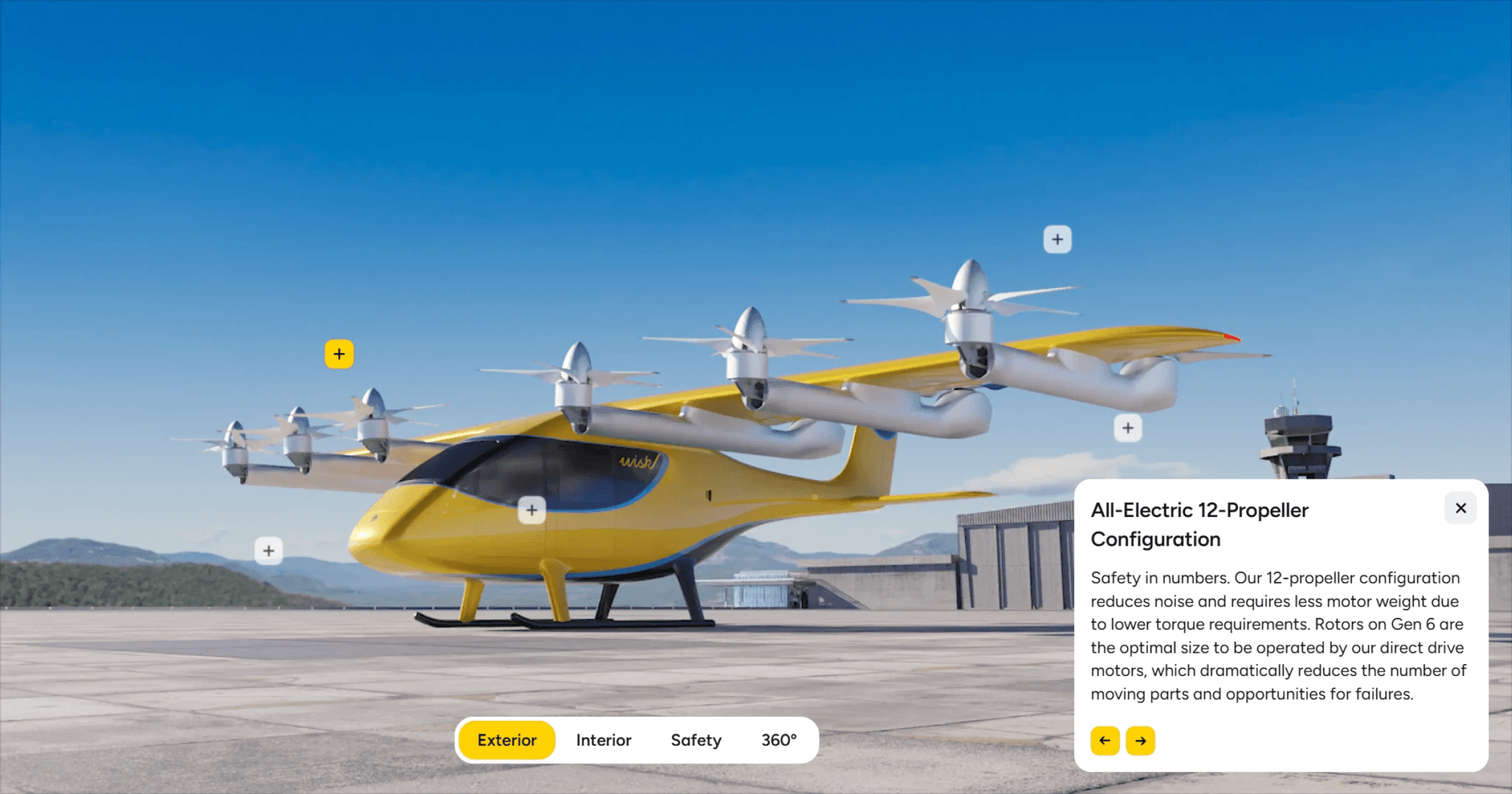
The answer was a scroll-driven image sequence. As the user scrolls, the aircraft progresses through its full flight sequence, frame by frame. It's not a video. It's not a looping background animation. It's tied to the user's pace, which changes how it lands entirely.
We built over ten of these custom animation sequences across the site using Framer's override system. Each one had a specific job: show the aircraft from a different angle, walk through a stage of the autonomy system, explain a technical concept without a technical briefing. The result is a site that communicates through motion, not just copy.
Keeping it fast
Custom scroll animations come with a cost: file size. A cinematic experience that stutters on a 4G connection in a boardroom is worse than no animation at all.
The entire asset pipeline was built around this constraint. We served imagery through AWS S3 and CloudFront with Bunny CDN layered in for edge delivery. Assets preload based on scroll position so the next sequence is always ready before the user reaches it. Every animation was tested across devices and connection speeds, not just on a MacBook on fast wifi.
The 360-degree aircraft explorer required a different approach. Rather than a single heavy asset, we broke it into a sequence of compressed frames and built the interaction logic around smooth transitions between them. The result feels fluid. The file overhead stays manageable.
This is one of the most common mistakes on Framer builds with heavy interactivity: the animations work beautifully in the design tool and fall apart in production. Building the delivery infrastructure early, before it becomes an emergency, is what separates a performant Framer site from a slow one.
Building for scale
Two months is a short runway for a build this ambitious. The only way to move that fast without cutting corners is to be disciplined about structure before touching a single component.
We built the entire site on a reusable component system in Framer. Every section type, hero, feature callout, media block, careers listing, was built once and templated. New pages were assembled from existing components rather than built from scratch each time.
This approach paid off twice. First during the build, where the team moved faster on every subsequent page. Second after launch, where Wisk's marketing team could expand the site themselves without unpicking the underlying structure.
Component architecture in Framer is often treated as a nice-to-have. On a site that needs to scale, it's the whole point. It's also the foundation of how we approach every Framer marketing site we build.
CMS and integrations
The CMS was configured around how Wisk actually creates content, not how a generic CMS organises it. The newsroom, resource library, and careers listings are independently manageable and consistent with the design system throughout.
HubSpot handles all lead capture and form routing. Each form type maps to the correct HubSpot workflow so the right people at Wisk get notified and no leads fall through. Careers was architected with Workday integration scoped from day one, so the hiring operation can scale without requiring a rebuild to implement it.
Getting integrations right at the start matters more than most clients expect. Retrofitting them into an existing Framer build is always slower and messier than building the hooks in early.
What Launched
Eight weeks after the brief, the site went live. Scroll-driven aircraft sequences across the full journey. A 360-degree explorer. A media centre and newsroom. A careers infrastructure ready for Workday. HubSpot fully wired in. Performance holding up under real-world conditions across every device.
Diane Stember, Wisk's Creative Director: "They've helped us bring our vision to life and go live in an extremely compressed time schedule."
The site now matches what Wisk is actually building. Autonomous flight isn't abstract. It's visual, interactive, and credible. And when the next milestone lands, the team can publish it without calling us. You can see the full build in the Wisk case study.
That's what a well-structured Framer build makes possible. We took a similar approach for Sydecar's Framer rebuild, another credibility-first build for a company operating at enterprise scale.

Harish Malhi
Founder of Goodspeed
Harish Malhi is the founder of Goodspeed, one of the top-rated Bubble agencies globally and winner of Bubble’s Agency of the Year award in 2024. He left Google to launch his first app, Diaspo, built entirely on Bubble, which gained press coverage from the BBC, ITV and more. Since then, he has helped ship over 200 products using Bubble, Framer, n8n and more - from internal tools to full-scale SaaS platforms. Harish now leads a team that helps founders and operators replace clunky workflows with fast, flexible software without writing a line of code.
Frequently Asked Questions (FAQs)
How long does it take to build a Framer website?
Most marketing sites take four to eight weeks. The Wisk build, with custom animations, a 360-degree explorer, and third-party integrations, launched in two months. Simpler sites move faster.
Can Framer handle complex animations without slowing the site down?
Yes, but it requires deliberate engineering. Asset optimisation, scroll-based preloading, and a CDN are non-negotiable on animation-heavy builds. Skip any of those and it falls apart in production.
Is Framer a good choice for enterprise or well-funded companies?
For marketing sites, yes. It's fast to build, produces high-quality output, and non-technical teams can manage it after launch. We've used it for Boeing-backed Wisk Aero and Series A fintech Sydecar, among others.
Can you integrate HubSpot and other tools with a Framer site?
Yes. HubSpot, Workday, and most major third-party tools integrate cleanly. Scope them before the build starts, not after.
Do you need a developer to update a Framer website after launch?
No, if it's built with a proper CMS and component system. Your marketing team can publish pages, update content, and manage listings without touching code.
What makes Framer different from other website builders?
Design fidelity combined with development flexibility. You get custom interactions and fast, production-quality output without the bloated code most drag-and-drop builders produce. For marketing sites that need to perform at a high level, it's the best tool we've found.