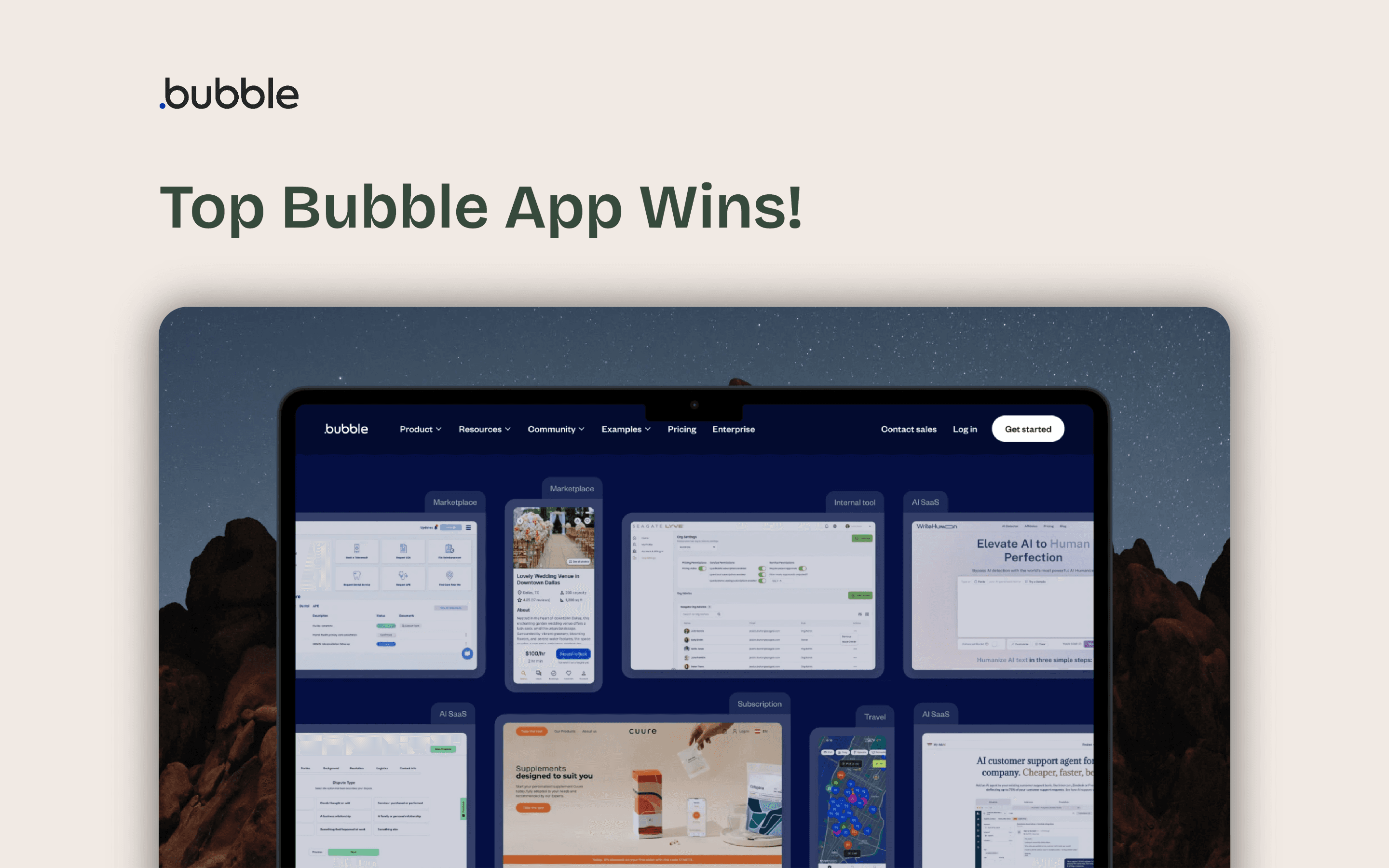
We evaluated apps with a discipline similar to an investor or enterprise technical buyer. The goal: include only live products where Bubble remained a material part of the stack and where there was credible evidence of real users, revenue, growth, or enterprise adoption. Looking to build your own Bubble success story? Goodspeed has helped ship over 200 no-code products, from MVPs to full-scale SaaS platforms.
Bubble has quietly become the most powerful no-code platform for SaaS founders. In the last five years, hundreds of products have moved beyond "MVP prototypes" and scaled into multi-million-dollar businesses, enterprise-grade platforms, and even VC-backed success stories.
But here's the problem: the market is noisy. Some "Bubble apps" are student projects, others are abandoned MVPs, and only a select few demonstrate true scale, traction, and repeatable playbooks.
This article is the most comprehensive analysis yet of successful SaaS and marketplace apps built on Bubble. You'll find:
Top 20 apps, spanning SaaS, marketplaces, internal tools, education, fintech, health, and AI.
Precise traction data (funding, revenue, user base, MAU, etc.) so you can benchmark your own progress.
Bubble-specific implementation details. How they optimized WUs, managed scale, and integrated with external systems.
Category winners for SaaS, marketplaces, AI-first, mobile-first, and enterprise adoption.
Lessons and patterns that every founder can apply: from how to avoid workflow bloat to when to pair Bubble with custom code.
Looking to build your own Bubble success story? Goodspeed has helped ship over 200 no-code products, from MVPs to full-scale SaaS platforms.
Skip straight to methodology if you want to see how we scored apps.
How We Chose
We evaluated apps with a discipline similar to an investor or enterprise technical buyer. The goal: include only live products where Bubble remained a material part of the stack and where there was credible evidence of real users, revenue, growth, or enterprise adoption.
Why Goodspeed for Your Bubble Project
At Goodspeed, we've built Bubble products across every category in this guide: SaaS platforms, marketplaces, internal tools, and enterprise applications.
We understand the patterns that separate successful Bubble apps from abandoned MVPs because we've implemented them hundreds of times.
Our team applies the same discipline you'll see in these success stories: WU optimization, proper architecture, performance monitoring, and hybrid stack design when needed. Whether you're validating an MVP or scaling to enterprise adoption, we help founders move from concept to revenue without hiring a full engineering team.
Talk to experienced Bubble developers about your project.
Eligibility & Verification
Must be a live product with public evidence of usage, revenue, funding, press coverage, or founder-verified metrics.
We cross-referenced company sites, press mentions, founder posts, and Bubble community case studies to validate claims.
Excluded apps that moved entirely off Bubble long before their growth stage.
Signals Considered (scored 1–5)
Product–market fit / traction
UX & reliability
Performance & WU discipline
Scalability & architecture choices
Security & compliance posture
Build velocity & roadmap transparency
Integrations & ecosystem fit
Community proof (reviews, case studies)
How We Used Evidence
We prioritized first-party evidence (founder notes, official press releases) and reliable secondary coverage.
Where the dataset included explicit metrics (MRR, users, funding), those were highlighted; where numbers were missing we focused on qualitative signals (enterprise logos, public awards, or case-study depth).
Quick Filters
Industries
Founder insights
We collected qualitative patterns and direct lessons designers and founders often mention when reflecting on their Bubble builds.
Speed and learning
Founders repeatedly emphasize that Bubble allows them to iterate faster and validate hypotheses in weeks rather than months. Formula Bot (MVP in 2 days) and Geteaiway (live in five days) are commonly cited examples.
When Bubble is the right choice
If you need to validate product-market fit quickly, move to revenue without hiring a full engineering team, or build polished admin tooling fast, Bubble is often the right first choice. Need help determining if Bubble fits your project? Work with our Bubble team to evaluate your requirements.
When to augment or replace
High-throughput compute, heavy ML inference, global bank integrations with custody responsibilities, or inconsistent WU patterns are reasons teams add external microservices. Successful teams migrate small, well-encapsulated subsystems rather than rewrite everything at once.
Operational hygiene
Performance wins are almost always the result of discipline: no unbounded repeating-group searches, server-side actions for heavy tasks, strict use of option sets and privacy rules, pagination, and caching.
What Bubble Enables
These are the concrete design patterns we saw in the strongest builds:
Server-side actions for heavy work
Move parsing, heavy computations, and LLM calls to serverless functions (AWS Lambda, Render, etc.) and call them as API endpoints from Bubble. Cache results in Bubble's DB.
Pagination + indexed searches
Replace UI-side "Do a search for…" inside repeating groups with paginated server-side queries or precomputed summary records.
Option sets and normalized data
Use option sets where possible for enums and standard attributes to minimize DB row explosion and simplify privacy rules.
Privacy rules & minimal PII in-app
When handling sensitive data, keep minimal identifiers in Bubble and store the rest in encrypted stores; surface only what the UI needs.
WU awareness & monitoring
Add instrumentation (webhooks that report estimated WUs) and throttling for key workflows to prevent surprise bills.
Hybrid stacks
Treat Bubble as the UX & orchestration layer; keep compute, heavy ML, and long-running jobs in purpose-built services.
Release & testing cadence
Use Bubble's staging environment, test suites, and feature-flag patterns; prefer incremental rollouts for reliability.
These patterns are what we implement in every Bubble build at Goodspeed. Want to build with these best practices from day one? Talk to our Bubble experts.
Real World Bubble Success Stories by Goodspeed
These real-world Bubble success stories show how teams use no-code to launch, optimize, and scale serious products. Each example below is a live product built by Goodspeed using Bubble.
GetAIWay
GetAIWay is an AI-powered travel planning product built on Bubble in just five days. After launch, it attracted thousands of users and generated tens of thousands of itineraries, proving Bubble can support fast-moving AI-driven SaaS products.
Pockla
Pockla is an AdTech SaaS MVP built with Bubble, featuring complex dashboards, onboarding flows, SlackBot automations, and AI-enabled content workflows. The project shows how Bubble can handle multi-feature SaaS products with real integrations and business logic.
MyAskAI
MyAskAI is a Bubble app optimized by Goodspeed to significantly improve performance at scale. CPU usage was reduced by around 30%, resulting in faster load times and a more reliable experience as the product grew.
Ready to Build Your Bubble Success Story?
The apps in this guide share one thing: they moved from idea to revenue faster than traditional development would allow. That's what Bubble enables when built right.
At Goodspeed, we've helped over 200 founders do exactly that. We handle the technical complexity (WU optimization, architecture, integrations, scale) so you can focus on product-market fit.
Book a free consultation to discuss your Bubble project.
Already have a Bubble app? Get a FREE detailed performance and conversion audit.

Harish Malhi
Founder of Goodspeed
Harish Malhi is the founder of Goodspeed, one of the top-rated Bubble agencies globally and winner of Bubble’s Agency of the Year award in 2024. He left Google to launch his first app, Diaspo, built entirely on Bubble, which gained press coverage from the BBC, ITV and more. Since then, he has helped ship over 200 products using Bubble, Framer, n8n and more - from internal tools to full-scale SaaS platforms. Harish now leads a team that helps founders and operators replace clunky workflows with fast, flexible software without writing a line of code.
Frequently Asked Questions (FAQs)
Can Bubble handle 100K MAU?
Yes, but 'can' depends on how the product is built. Apps that reach that scale separate the UI layer (Bubble) from heavy compute and use server-side summarisation and pagination. For example, teams that reported large concurrent usage used caching layers, background summarisation jobs, and selective data denormalisation to keep UI queries fast.
How do I keep WU usage predictable?
Design for predictability: queue heavy workflows, avoid repeating searches, throttle actions, cache expensive results, and monitor WU per event. Use server-side endpoints for logic that would otherwise trigger many database hits.
Should I use Bubble's native mobile builder or a wrapper?
If native mobile features are core, plan for native or a robust wrapper from day one. If mobile is secondary, a mobile-optimized web app or wrapper is faster to launch. Many teams start with a wrapper and go native once metrics justify it.
Is vendor lock-in a risk with Bubble?
Vendor lock-in is real, but manageable. Adopt an API-first mindset: design systems so that data and business logic can be called via APIs. Keep your export strategy ready (regular backups, exportable data models). Most teams migrate incrementally: replace bottleneck microservices first and keep Bubble as the orchestration/UI layer until costs or scale force deeper migration.
What types of successful businesses have been built on Bubble?
Multi-million-dollar SaaS products, enterprise platforms, and VC-backed startups across every vertical: marketplaces, internal tools, edtech, fintech, health, travel, real estate, and HR/recruitment. Want to join them? Goodspeed builds production-ready Bubble apps across all these industries.
How can I tell if a Bubble app is truly scalable and production-ready?
Look for real traction: usage metrics, revenue data, funding, enterprise adoption, and press coverage. Technical indicators include WU optimization, performance discipline, proper security posture, and architecture that separates UI from heavy compute. These qualities separate scalable businesses from abandoned MVPs.
What are the common patterns used by successful Bubble apps at scale?
Separate UI from heavy compute, use server-side pagination and caching, run background jobs for intensive tasks, apply selective data denormalization, and integrate external systems via APIs. Convert synchronous workflows to queued jobs and avoid operations that cause excessive database hits.