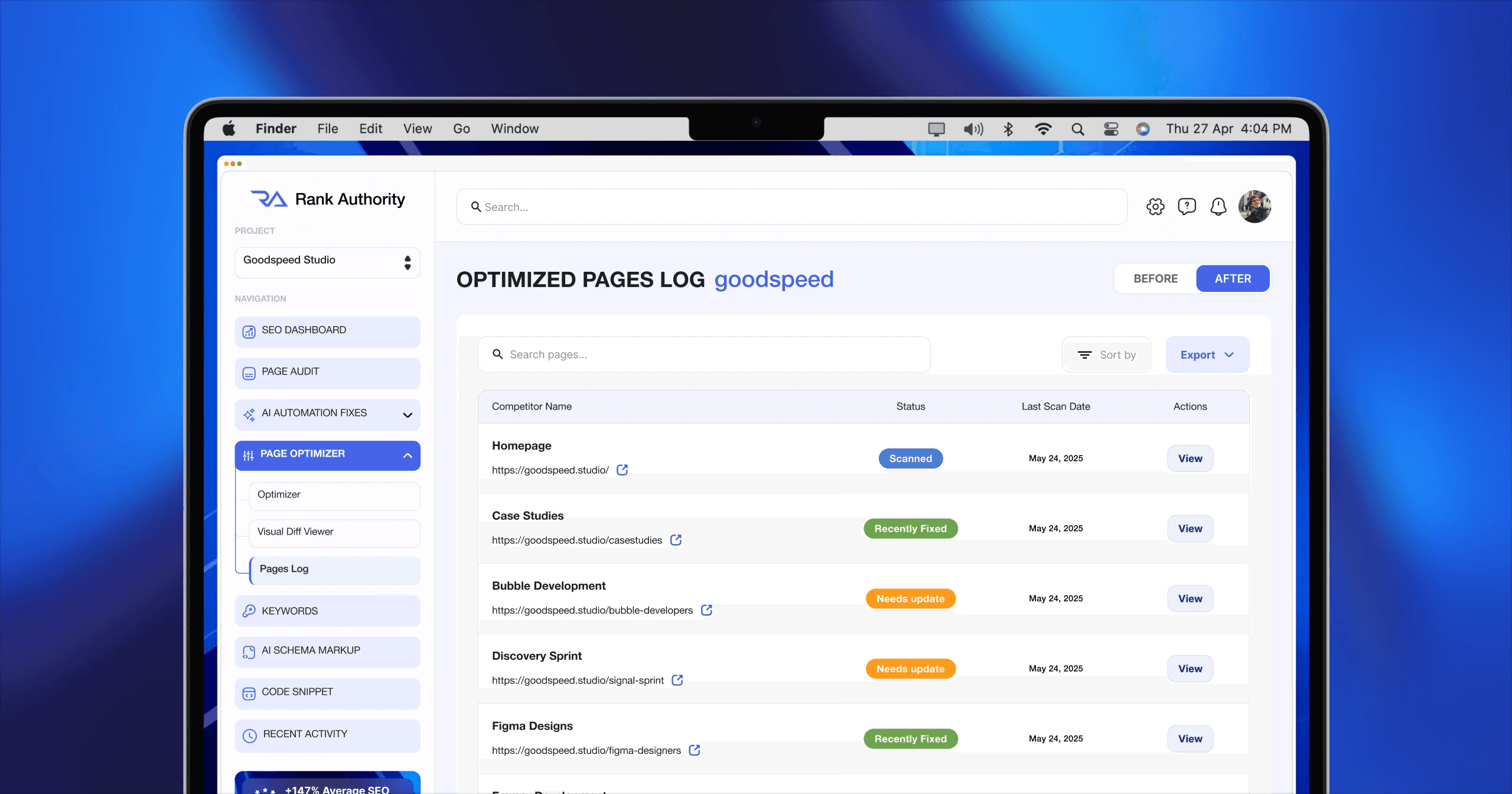
How Goodspeed shipped Rank Authority, an AI SEO SaaS with 8 LLM providers, in four months using Cursor, Replit, and n8n. Prototype-first thinking, an AI-assisted dev workflow, and a handover Bryan's team could run with.
Start with the scary part
The hardest feature was AI Visibility. The idea was simple to explain. Every week, run prompts across eight AI providers. Count where the business shows up. Report back. The execution had a thousand decisions baked in. Provider rate limits. Prompt phrasing. Scoring logic. What to do when one provider returns something the other seven don't.
We didn't trust ourselves to scope it sight unseen. So before contracts or formal documents, we built a working prototype in Replit, shared it with Bryan, and let him push on it. Only then did we write the real scoping document. That single decision is why the feature shipped in under six weeks with almost no rework.
Prototyping the riskiest part first has become a non-negotiable. It's the same instinct we lean into when clients run a Discovery Sprint before committing to a full build. Don't pretend you know what you don't. Build the riskiest ten percent first.
Cursor in the middle, not at the edges
For the bulk of the build, Cursor sat in the middle of our workflow. Billing. Dashboards. WordPress integrations. The AI features. Everything moved through it.
We're not romanticising this. Cursor isn't a magic wand. What it changed was the ratio of time spent on judgement versus time spent on plumbing. Wiring a new endpoint. Adjusting a Stripe webhook. Updating type definitions across a dozen files. That's the work that used to eat afternoons and now eats minutes.
The afternoons we got back went into the things that needed thinking. How the dashboard should feel for someone who isn't an SEO specialist. The right cadence for re-scanning a site. How to handle the awkward middle state where a user has signed up but their first crawl hasn't finished. That's the shift. AI tools don't write the product for you. They give you back the hours that used to disappear into mechanical work, so you can spend them on the parts that need a human. Most of the AI products and SaaS platforms we ship now are built this way.
n8n as the quiet hero
Underneath the dashboard, Rank Authority is an automation product. The interface is the visible ten percent. The rest is a backend that fires prompts across eight AI APIs in parallel, schedules and publishes blog content into WordPress, and re-scans every active subscriber's site weekly. Without a human anywhere near the start button.
We orchestrated all of it in n8n. What would have been weeks of bespoke job-runner infrastructure became a system we could build, debug visually, and hand over cleanly. If you're considering similar territory and want a deeper read on how we structure these flows, our n8n playbook covers the patterns we lean on.
n8n also kept the build legible. When a failure mode showed up, like a provider rate-limiting us at the wrong moment, or a WordPress site rejecting an image upload, Bryan's team could see exactly where it broke. That visibility matters more than any single technical choice we made.
The handover, which is really the point
Rank Authority went live with a working subscription system, free-trial coupons, and every feature running in production from day one. The part we're most proud of isn't on the launch checklist though. It's that Bryan's team can take it forward without us in the room.
"I'm absolutely very impressed with what Goodspeed have put together. The dashboard, the design, the layout, everything about it. It is just absolutely wonderful."
Bryan D'Antonio, Founder
Clean handovers are rare in first-time SaaS launches. They're rare because most agencies optimize for being indispensable. We optimize for the opposite. The work is documented. The automations are inspectable. The next feature doesn't need our sign-off.
What we'd say to anyone building something similar
Build the scary thing first. Use AI tooling to clear the busywork so you can spend your attention where it actually counts. Pick orchestration tools that someone else can read six months from now. And find a partner who treats handover as a feature, not a goodbye.
If you want to see more of how we approach this kind of work, our case studies cover everything from SaaS MVPs to AI-first products. Got a Bryan-shaped problem of your own, something you've wanted to build for ages and don't know where to start? Let's talk.

Harish Malhi
Founder of Goodspeed
Harish Malhi is the founder of Goodspeed, one of the top-rated Bubble agencies globally and winner of Bubble’s Agency of the Year award in 2024. He left Google to launch his first app, Diaspo, built entirely on Bubble, which gained press coverage from the BBC, ITV and more. Since then, he has helped ship over 200 products using Bubble, Framer, n8n and more - from internal tools to full-scale SaaS platforms. Harish now leads a team that helps founders and operators replace clunky workflows with fast, flexible software without writing a line of code.
Frequently Asked Questions (FAQs)
How long does it take to build an AI SaaS?
Rank Authority shipped in four months with a beta-ready subscription system, eight LLM providers wired in, and every feature running in production. Timelines vary by scope, but the speed comes from prototyping the riskiest features first and using AI-assisted development to clear plumbing work.
What is AI Visibility tracking?
AI Visibility tracks how often a business gets mentioned across AI tools like ChatGPT, Perplexity, and other LLM providers. Rank Authority runs prompts across eight providers each week, counts where the business shows up, and reports the trend back to the user.
Why prototype in Replit before scoping?
Replit lets us build a working version of the hardest feature before any formal scoping document. Sharing it early with the client surfaces edge cases, validates assumptions, and removes rework once production builds start. The AI Visibility feature shipped in under six weeks because we prototyped first.
Why use n8n for SaaS automation?
n8n handles backend orchestration without weeks of custom infrastructure work. For Rank Authority, it fires prompts across eight AI APIs in parallel, schedules content publishing into WordPress, and re-scans every active subscriber's site weekly. The flows are visual, debuggable, and easy to hand over.
Does Goodspeed hand over the codebase after launch?
Yes. Rank Authority shipped with full documentation, inspectable automations in n8n, and a structure the client team could take forward without us. Clean handovers are part of how we work, not an afterthought.