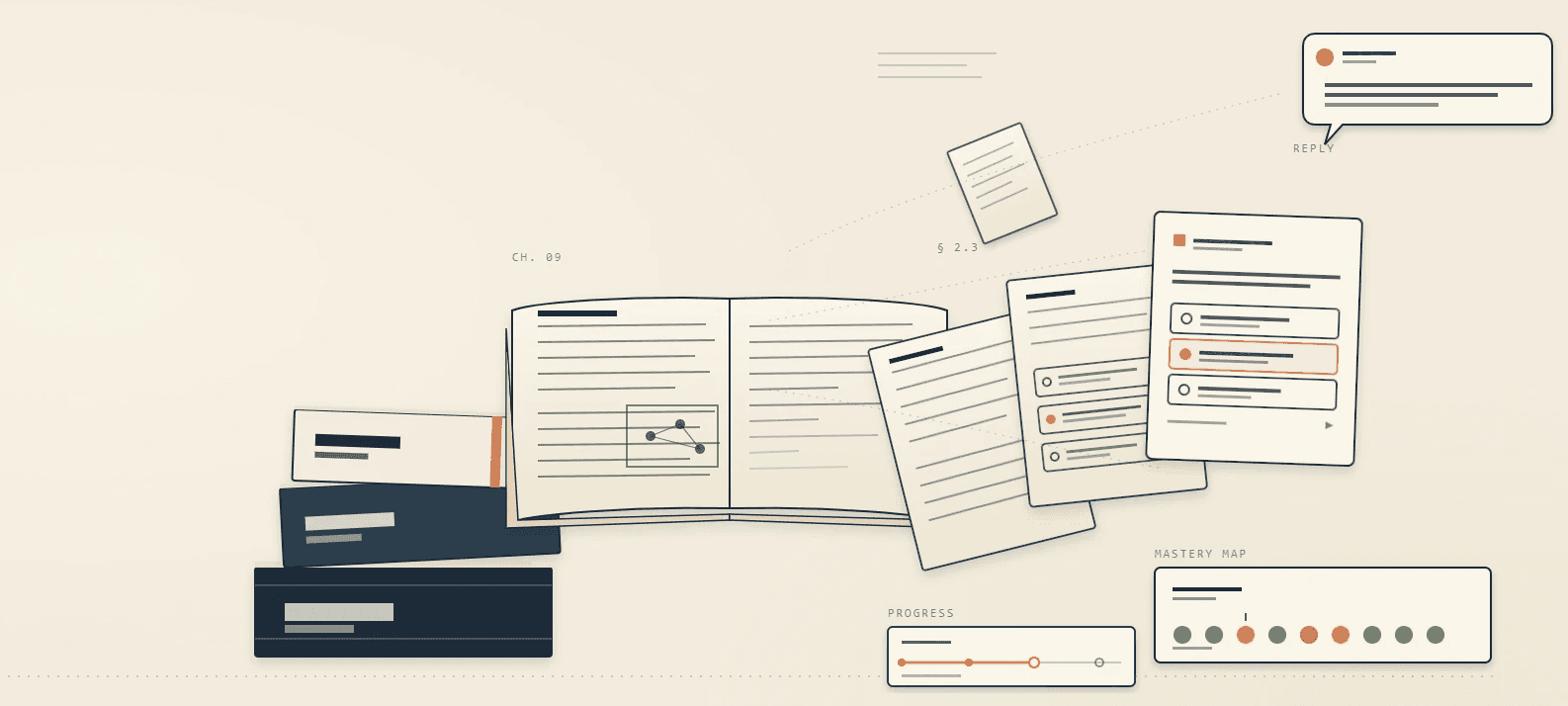
We helped an educational publisher turn 60,000 pages of textbook content into interactive learning tools: quizzes grounded in the chapter, an AI tutor acting as a study buddy, and a mastery map teachers can actually use. The story of the build, the pilot classroom, and what publishers should take away.
The problem: 60,000 pages of textbook content stuck in static formats
The publisher had been building curriculum content for decades. They had something most publishers would envy: a back catalogue of around 60,000 pages of textbook content, written by real subject matter experts, rigorously edited, trusted by schools. They also had the problem most publishers know by heart and rarely say out loud.
The content worked. The format didn't.
Ebooks, PDFs, static digital versions. A student opened the page, read, closed the tab, got on with their evening. The content was doing one job, being read, when the publisher knew it could do four or five. Being used. Questioned. Practised with. Adapted to the student's own ceiling of understanding.
The publisher came to us with a question that wasn't quite a brief. "Is there a sensible version of this where the textbook is still the textbook, but the student can actually do something with it?"
Why "add a chatbot" and "build a platform" both miss the point
A publisher's biggest asset is the content. It's also their biggest frustration. Every editor we spoke to said the same thing in different words. The students read it once, and then they never see the behaviour they want to see. No repeat engagement. No practice loops. No signal of whether a concept had landed or just scrolled past.
You can tell when a student gets stuck. You can also tell when they don't. A static ebook can't tell the difference.
There are two wrong answers publishers usually try first. The first is to bolt on a chatbot. Slap a generic AI widget on the corner of the page. The students use it once, ask it to write their homework, and stop. The second is to commission a full adaptive platform. Five-year roadmap, board-level business case, two consultancies, nothing in classrooms for three years.
We wanted to find the thing in the middle. Something real enough to land in a classroom in weeks. Sharp enough that a teacher would see a point to it. Tied to the publisher's own content tightly enough that a parent would recognize the material in the interactive version.
Where we started: one subject, one classroom
We started small on purpose.
One subject. One set of chapters. One specific cohort of secondary school students already using the publisher's material inside a national schools programme. A pilot that could actually be observed, with teachers who were already in the room. Not 60,000 pages on day one. Not the full catalogue. A slice that could get in front of real learners and earn its right to grow.
The bet was this: if we could make a single chapter worth using for a single class, the approach would survive the full backlist. If we couldn't, we had no business touching it.
What we built on top of the publisher's content
We built an interactive layer that lives on top of the publisher's existing textbook content. Same words. Same pages. Same authorial voice. Different experience.
The student opens a chapter. The chapter is still the chapter. But where a diagram used to sit, there's a diagram they can interact with. Where a concept is usually explained in a paragraph, they can ask the AI tutor to explain it again, at their level, without leaving the page. At the end of a section there's a quick diagnostic. Get something wrong, the tutor doesn't just mark it red. It opens a conversation. It walks them through why.
Behind the scenes, the content is built as a set of typed activity objects tied to specific concepts in the text. Multiple choice questions for retrieval practice. Multiple answer when more than one option is right. Short scenarios for applied learning. Sort and classify for structural concepts. Animated slideshows for anything process-based. A misconception detector where the student picks the plausible-but-wrong answer first, so the tutor can tackle the misconception rather than the answer.
The teacher gets the other side of the story. A mastery map, concept by concept, colour-coded. Green, amber, red. A class pulse for the morning briefing. A sense of which students are stuck without having to ask them in front of the rest of the class.
The principle we kept coming back to, copied straight out of the client's first brief: the tutor isn't a chatbot. It's a study buddy. The student doesn't start the conversation. The tutor does. The tutor knows what chapter the student is on, what the student has just answered, what the student tends to get wrong, and what the concept they're about to meet is about. That's the thing that moves the needle on active learning, and it's the thing a generic chat widget can't do.
What happened when students got their hands on it
The first live demo was in February. A few teachers around a table. The presentation went smoothly, which is a sentence you write once the nerves have passed.
A week later, the second demo. Also fine.
Then a full launch to ministry and school staff. Then the cohort enrolled. And then, in early March, one of our developers shared a single photo in our internal channel. A classroom. A student on an iPad. The app on the screen. The tutor mid-conversation.
One of the team wrote back: "That's why we do it."
By April, the client was sending more of those photos, unprompted. Students using the app. Not performatively. Not because a teacher told them to. Because the thing was working on its own terms.
Three takeaways for publishers
Three things, honestly.
The content is the asset. Everything we built sits on top of the publisher's own material. The tutor is grounded in the chapter, not in general knowledge scraped off the internet. That's what keeps the quality editorial-grade and the parents comfortable. If a vendor wants to layer an AI tool over your catalogue without ever looking at your catalogue, that's not the right vendor.
Start in one classroom. Every interactive publishing project we've seen succeed has started with one cohort of real learners, not a platform rollout. You can argue about product design in a meeting forever. You learn the most when a teacher sits down with a tablet and actually uses it.
The ceiling is the format, not the content. If your catalogue is still shipping as static ebooks in 2026, the thing you're competing with isn't the publisher down the road. It's every adaptive app a student can find online for free. The gap isn't small and it isn't closing.
If you're a publisher sitting on a catalogue and wondering what "interactive" actually looks like on your own content, happy to walk you through what we built. Book a call.

Harish Malhi
Founder of Goodspeed
Harish Malhi is the founder of Goodspeed, one of the top-rated Bubble agencies globally and winner of Bubble’s Agency of the Year award in 2024. He left Google to launch his first app, Diaspo, built entirely on Bubble, which gained press coverage from the BBC, ITV and more. Since then, he has helped ship over 200 products using Bubble, Framer, n8n and more - from internal tools to full-scale SaaS platforms. Harish now leads a team that helps founders and operators replace clunky workflows with fast, flexible software without writing a line of code.
Frequently Asked Questions (FAQs)
What are interactive learning tools for publishers?
Activities and feedback loops built on top of publisher content. Quizzes tied to the chapter, AI tutors grounded in the text, adaptive practice, concept-level mastery maps. The student does something with the content, not just reads it.
Does my whole catalogue need to come along at once?
No. Start with one title, one cohort, one subject. If the approach works on the narrow slice, widening is easier than starting.
Is this the same as adding a chatbot?
No. A chatbot sits next to the content and answers anything. An interactive layer is grounded in the chapter, opens the conversation itself, and is tied to specific concepts the student is meant to learn.
How long does it take?
Weeks to a first working version on a single title. Months to widen across a subject. Years if you try to do the whole backlist in one go, which is why we don't.
Does this work for academic or assessment content, or only textbooks?
Both. The objects change. The principle doesn't.