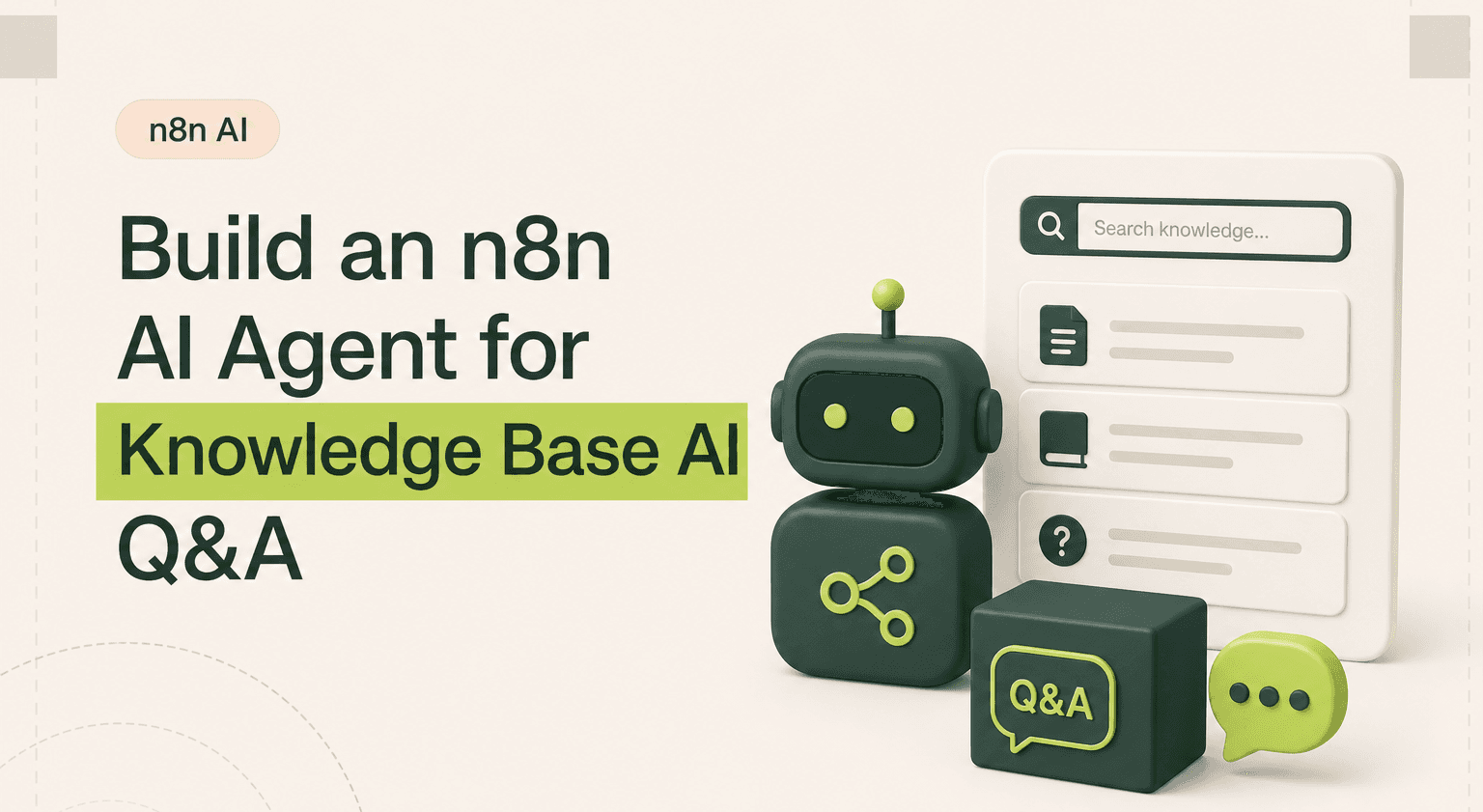
Your team asks the same questions every week. The answers exist in your docs, but nobody can find them. An n8n AI agent connected to your knowledge base answers questions instantly, grounded in your actual documentation.
This guide covers how to build a knowledge base Q&A agent using n8n RAG that your team will actually use.
TL;DR: Give your team an AI agent that actually knows your docs
Build a RAG pipeline with n8n automations: ingest from Notion, Drive, and Confluence, embed into Pinecone or pgvector, and answer questions in Slack.
Ground LLM responses in your real SOPs, HR policies, and engineering wikis so answers cite the source document.
Tune chunk size (300-500 tokens with 50-token overlap works for most internal docs) and add a low-confidence "I don't know" guardrail.
Audit your docs first; the agent only ships answers as good as the content it retrieves.
Complex ingestion with auto-sync and quality monitoring belongs with an n8n agency shipping AI products teams will actually use.
What an n8n AI Knowledge Base Agent Does
This agent takes a question from your team, asked in Slack, via a chatbot, or through email, and answers it using your internal documentation. It searches your knowledge base, retrieves the most relevant sections, and uses the LLM to synthesise a clear, accurate answer with source references.
This is the classic n8n RAG (Retrieval-Augmented Generation) pattern. Instead of the LLM relying on its generic training data, it draws from your specific SOPs, product docs, HR policies, engineering wikis, and onboarding guides. The result is answers that are actually correct for your organization.
Architecture: LLM + Vector Store + Document Ingestion
The system has two workflows. Workflow one handles ingestion: it takes your documents (from Notion, Google Drive, Confluence, or a folder of files), chunks them into sections, generates embeddings, and stores them in a vector database like Pinecone, Qdrant, or Supabase with pgvector.
Workflow two handles queries. A Slack message or webhook triggers the AI agent node. The agent’s first tool call searches the vector store with the user’s question. It retrieves the top 3-5 most relevant document chunks. The LLM then reads these chunks and generates an answer, citing which document each piece of information came from.
Memory is optional but useful. With n8n’s conversation memory, the agent can handle follow-up questions: "What about for contractors?" references the previous question’s context without the user restating it.
Example Prompt and Output
An employee asks in Slack: "What’s our policy for requesting time off during a client project?"
The agent searches the vector store. It retrieves chunks from the HR policy document and the project management SOP. The response: "Per the HR handbook (updated Jan 2026), time off during active client projects requires approval from both your project lead and the HR team at least 5 business days in advance. For projects in the final delivery sprint, the project lead may defer the request until after delivery. See the full policy in HR Handbook § 4.3." Posted as a Slack thread reply.

Work with us
Build a knowledge base agent your team can trust
Talk through your document sources, retrieval needs and quality checks with Goodspeed.

Real Limitations and Edge Cases
The agent is only as good as your documentation. If your docs are outdated, contradictory, or incomplete, the agent serves bad answers confidently. Before deploying this agent, audit your knowledge base. Remove stale content. Mark documents with last-updated dates.
Chunking strategy matters more than people think. Chunk too large and the vector search returns irrelevant context. Chunk too small and the agent lacks enough context to answer properly. For most internal docs, 300-500 token chunks with 50-token overlap works well. Test with your real questions.
The agent should say "I don’t know" when it cannot find relevant documentation. Without explicit instructions, LLMs fill gaps with guesses. Add a confidence check: if the vector search returns low similarity scores, the agent should respond with "I couldn’t find a clear answer in our docs. Try asking [person/team]."
When This Works Best
This n8n AI agent is ideal for companies with 20+ employees where institutional knowledge is scattered across multiple tools. Engineering teams, customer success teams, and new hires benefit most. It is one of the most universally applicable n8n use cases because every company has a knowledge retrieval problem.
When to Hire an Agency
The ingestion pipeline is the hardest part. Connecting to multiple document sources, handling different file formats, keeping the vector store in sync as documents change, and tuning the retrieval quality all require significant iteration. An n8n agency can set up a robust ingestion pipeline with auto-sync and build the quality monitoring that tells you when the agent is serving bad answers.
Give Your Team Instant Answers
An n8n AI agent for knowledge base Q&A eliminates the friction between having documentation and actually finding it. With n8n integrations for Slack, Notion, Google Drive, and Confluence, you can connect all your document sources into a single searchable agent. The n8n workflow handles both ingestion and querying in one platform.
Deploy Your Knowledge Base Agent
Your docs are only useful if people can find the answers. An n8n AI agent with RAG makes your entire knowledge base searchable in natural language. Goodspeed builds knowledge base agents with robust ingestion pipelines and retrieval tuning.
Frequently asked questions
What is RAG and why does it matter for a knowledge base agent?
Which vector databases work with n8n?
How do I keep the knowledge base agent updated when docs change?
Can the agent handle follow-up questions in a conversation?
How do I prevent the agent from making up answers?
What document sources can I connect to the knowledge base agent?

Harish Malhi
Founder of Goodspeed
Harish Malhi is the founder of Goodspeed. He left Google in 2019 to build his own product, and started Goodspeed to give other founders the same head start. Today the studio designs and builds websites and the whole digital experience around them for funded tech companies, at the moments that matter: a raise, a launch, a press cycle. Goodspeed is a Framer Enterprise Expert, was Bubble’s Agency of the Year in 2024, and has shipped 300+ products, including launch pages for an NVIDIA-backed AI lab and a Webby-nominated site for a Boeing-backed aviation company. It holds a 5.0 rating from 46 reviews on Clutch.