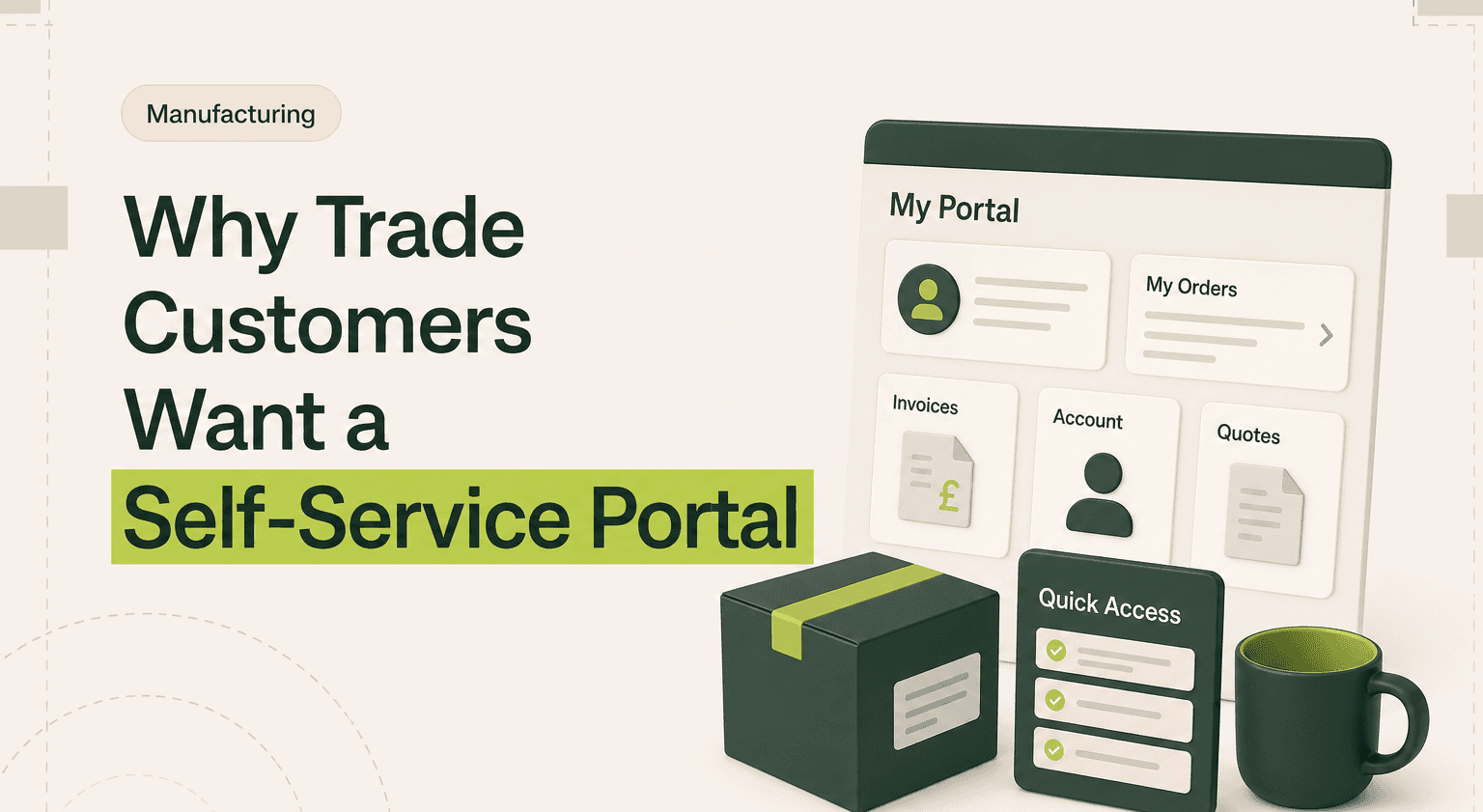
Your trade customers order from Amazon, book flights online, and manage their banking on an app. Then they call you for a quote and wait 48 hours. The friction is costing you orders. A trade customer portal lets them log in, see their pricing, configure products, and order - 24/7. We build these in 8-12 weeks on Bubble. No enterprise software required.
The Expectations Gap
Your trade customers live in two worlds. In one world, they order from Amazon Prime and receive goods in 24 hours. They book flights on Skyscanner and flights confirm instantly. They manage their banking through an app that updates in real-time. They use Slack, Asana, Notion - all integrated, all accessible 24/7. This is their expectation. Instant, transparent, self-service.
Then they need to order from you. They call your sales team. They wait for someone to answer. They explain what they need. The rep says "I'll send you a quote." Two days later, an email arrives with a PDF. They review it. They have questions. They email back. Another 24 hours pass. They get answers. They approve. They place an order. The entire process takes a week.
This friction is the norm in B2B wholesale. But it shouldn't be. Your trade customers are frustrated by it. They're used to better. And they're starting to choose suppliers partly based on how easy it is to buy.
The expectations gap exists because the wholesale industry hasn't modernized. Most wholesalers and distributors still operate like it's 2005 - email-based quoting, manual order processing, no online visibility. Meanwhile, their customers have moved on. They want to log in, see their pricing, browse products, configure orders, and place them instantly.
What Trade Customers Actually Want
A trade customer portal needs to do one thing well: make buying frictionless. Here's what that actually means. A customer logs in with their credentials. They see a customized catalogue - only products relevant to their industry or location. They see their negotiated pricing - not the same price as everyone else, but their specific contract pricing. They can browse, search, filter, and configure products if needed.
When they find what they want, they add it to a cart. The system shows their per-unit price, their volume discounts if applicable, their delivery terms. They can request a quote if the order is above a certain threshold, or they can place the order directly if it's within their standard approval limits. The order goes into your fulfillment system immediately. No manual entry. No email confirmation that gets lost in someone's inbox. The customer gets an order number, tracking, and delivery updates automatically.
They can also see their order history, their open orders, their billing history, their payment status. They can reorder with a single click because the system remembers what they've previously bought. If they have a question about an invoice, they can see it instantly instead of emailing your accounts team and waiting.
This isn't Shopify. Shopify shows the same price to every customer. A trade portal shows customer-specific pricing, volume tiers, custom catalogue segments, approval workflows, and credit terms. It's built for B2B relationships, not B2C commerce.
What a Trade Portal Includes
A trade portal has five core components. First: customer authentication and account management. Customers log in with their credentials, their permissions are checked, and they see only products and pricing relevant to their account. No one sees anyone else's pricing.
Second: a product catalogue. If your product range is simple (20-100 SKUs), this is straightforward - a searchable, filterable list with product details, images, and availability. If your range is complex (1,000+ SKUs), you need more sophisticated tools - category hierarchies, advanced filters, search-as-you-type. We typically recommend a lightweight approach at first and expand based on customer feedback.
Third: a configurator if you have configurable products. This is especially important for complex products - textiles, signage, custom materials. Customers specify their requirements - dimensions, materials, colours, finishes - and the system shows pricing in real-time. This self-service specification builds confidence and reduces support tickets.
Fourth: a quoting and ordering system. Simple orders go straight through. Complex orders trigger a quote workflow - the customer submits their specs, your team reviews and approves, the customer gets a formal quote, they approve it, and it converts to an order. This handles edge cases without killing the frictionless flow for standard orders.
Fifth: order management and tracking. Customers can see their open orders, their order history, delivery status, and invoicing. They can download documents - purchase orders, invoices, delivery confirmations - without asking your team.
The ROI of Self-Service
A trade customer portal delivers measurable ROI in two directions. First: operational efficiency. Your team isn't emailing quotes anymore. Your sales reps aren't spending 30% of their time on routine reorders. Your accounts team isn't answering "when was I charged for that?" questions because customers can see their invoices instantly. We typically see 40-50% reduction in customer service calls within the first three months.
Second: customer acquisition and retention. When your ordering experience is better than your competitors, you win business. When ordering from you is frictionless, customers stay. We see order frequency increase 20-35% because reordering is so easy that customers order more frequently in smaller batches instead of bulk orders. We see customer lifetime value increase because the relationship is less friction and more value.
There's also the competitive advantage. If 93% of wholesalers still quote by email and you've got a portal, you're the obvious choice. Customers talk. Your reputation for ease-of-doing-business spreads. You become the default supplier in your category not because your products are better, but because buying from you doesn't hurt.
How to Build One Without Enterprise Software
You don't need a six-figure enterprise solution. You don't need NetSuite or SAP. You need a modern, purpose-built portal that connects to your existing systems. We build these on Bubble - a no-code platform that handles authentication, databases, integrations, and front-end interfaces. The timeline is 8-12 weeks depending on complexity. The cost is £20,000-50,000 depending on integration complexity and configurator sophistication.
The implementation breaks down like this: weeks 1-2 are discovery and design - you define your product structure, customer tiers, pricing rules, and ERP integration points. Weeks 3-8 are build and testing. Weeks 9-12 are refinement, staff training, and launch. You own the final product - no per-user licensing, no ongoing vendor lock-in.
The critical success factor is preparation. You need clean product data - SKUs, pricing, availability. You need a customer database - account information, pricing tiers, credit terms. You need ERP integration points - we need to know how to pull order status, inventory, and invoices from your systems. If you show up organized, the project moves fast.
Common Objections (And Why They're Wrong)
Most wholesalers object with: "Won't this cut out our sales reps?" No. It cuts out the admin and lets them sell. Reps will still handle complex negotiations, relationship building, and problem-solving. But they won't spend 30% of their week emailing quotes. They'll spend that time on value-add activities.
Second objection: "Our customers want to talk to a person." Some do. Most want to do the routine stuff themselves and talk to a person only when needed. A portal doesn't eliminate the human element. It just reduces friction on the 80% of interactions that don't need a person.
Third objection: "This is expensive and complex." It isn't. 8-12 weeks, £20-50K, no per-user costs. You'll see ROI within 6-9 months through efficiency gains alone. Compare that to any enterprise software project and it's trivial.
Fourth objection: "We're too small for this." You're not. The smallest wholesaler we've built a portal for had £3m revenue. The payback was fastest for smaller companies because the operational efficiency gains are proportionally larger. Related reading: how to build a B2B ordering portal, self-serve ordering for B2B, why UK manufacturers still quote by email, Shopify alternative for trade, wholesale pricing strategy.
Your Competitors Are Already Building This
The question isn't whether your trade customers want self-service. They do. The question is whether you build it before your competitors do.
A trade customer portal on Bubble takes 8-12 weeks, costs £20-50K, and transforms how your customers buy from you. DM me if you want to scope one for your business.

Harish Malhi
Founder of Goodspeed
Harish Malhi is the founder of Goodspeed, one of the top-rated Bubble agencies globally and winner of Bubble’s Agency of the Year award in 2024. He left Google to launch his first app, Diaspo, built entirely on Bubble, which gained press coverage from the BBC, ITV and more. Since then, he has helped ship over 200 products using Bubble, Framer, n8n and more - from internal tools to full-scale SaaS platforms. Harish now leads a team that helps founders and operators replace clunky workflows with fast, flexible software without writing a line of code.
Frequently Asked Questions (FAQs)
What is a trade customer portal?
A private online platform where your wholesale/trade customers log in, see their specific negotiated pricing, browse your product catalogue, configure items, place orders, and track order history. It's like Shopify but built for B2B relationships. See our full guide on <a href="/blog/b2b-self-serve-ordering">B2B self-serve ordering</a>.
Won't my customers prefer talking to a sales rep?
75% of B2B buyers prefer to self-serve. They still want a rep available for complex orders or negotiations - but for repeat orders, reorders, and standard configurations, they want to do it themselves. Self-service doesn't replace your team. It frees them up.
How is this different from Shopify?
Customer-specific pricing, volume tiers, approval workflows, account management, credit terms, and ERP integration. Shopify assumes one price for everyone. A trade portal gives each customer their negotiated pricing.
What does it cost to build?
£20,000-50,000 on Bubble. No per-user licensing. You own it. Compare to £50,000-200,000 for enterprise solutions with ongoing per-user costs. Read why <a href="/blog/shopify-alternative-configurator">Shopify doesn't work for trade</a>.
How long before I see ROI?
Most businesses see 40% faster order processing within the first month. Customer service calls drop 60% because buyers can check order status themselves. Full payback within 6-9 months. See why <a href="/blog/uk-manufacturers-digital-ordering">93% of UK manufacturers still quote by email</a>.
Can it handle complex product configurations?
Yes. We've built portals with product configurators built in - customers can specify dimensions, materials, finishes, and see pricing update in real time before placing an order. That's the sweet spot for manufacturers with configurable products.