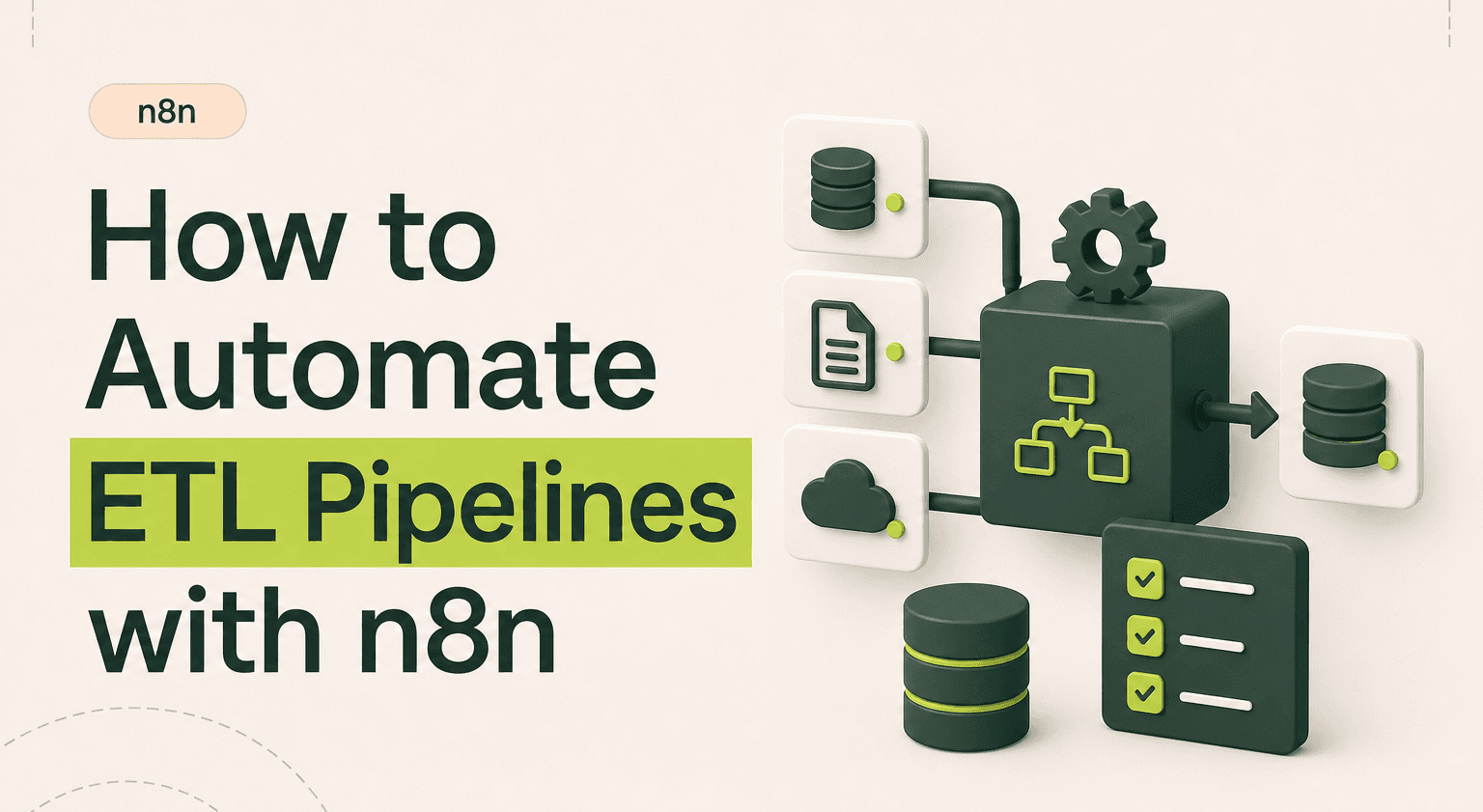
Your data lives in twelve different tools. Getting it into one place for analysis means export, clean, transform, import-repeated endlessly. Traditional ETL tools require a data engineer. You don't have one.
n8n ETL pipeline automation gives you visual, maintainable data pipelines that move and transform data between any system-no data engineering team required.
TL;DR: Visual ETL Without a Data Engineering Team
Extract from SaaS APIs, transform with Function and Set nodes, and load into Postgres, Sheets, BigQuery, or Snowflake using an n8n agency build.
Run incremental loads using stored timestamps so you only pull changed records and stay under API rate limits inside one automation flow.
Catch failures with Error Trigger nodes, retry transient errors, and log bad records to a dead-letter queue for manual review.
Replace 90% of what Fivetran does for moderate-volume SaaS pipelines at a fraction of the cost.
For multi-source pipelines with complex transformations, see our case studies and start a conversation.
What ETL Means for Modern Teams
ETL stands for Extract, Transform, Load. Extract data from source systems. Transform it-clean, restructure, enrich, calculate. Load it into the destination-a database, warehouse, or analytics tool. Every company does ETL, whether they call it that or not. Most just do it badly, with spreadsheets and manual copy-paste.
Traditional ETL tools like Fivetran, Airbyte, and Stitch are built for data engineering teams. They're powerful but complex, expensive, and overkill when you need to move data between a few SaaS tools. n8n fills the gap: a visual workflow builder that handles ETL for operations teams without requiring SQL expertise or infrastructure management.
When n8n ETL Pipelines Make Sense
n8n is the right choice for ETL when your sources are SaaS APIs rather than large databases, your data volume is moderate (thousands to hundreds of thousands of records, not billions), and you need transformation logic that's more complex than a simple field rename but less complex than a full dbt project.
Common n8n use cases for ETL include syncing customer data from your CRM to a data warehouse, aggregating marketing spend from multiple ad platforms into a single reporting table, transforming webhook events into structured records for analytics, and consolidating data from acquired companies into a unified system.
How n8n ETL Pipelines Work
Extract. n8n's native nodes and HTTP Request node pull data from any source. CRM records from HubSpot. Transactions from Stripe. Campaign data from Google Ads. Form responses from Typeform. Database queries from Postgres or MySQL. The trigger is typically a cron schedule-run daily at midnight-or a webhook for real-time processing.
Transform. This is where n8n shines for ETL. The Function node gives you full JavaScript for complex transformations. The Set node handles simple field mapping. The IF and Switch nodes filter records based on conditions. The Merge node joins data from multiple sources. The Split In Batches node handles pagination for large datasets.
Real-world transformations include normalising date formats across systems, calculating derived fields (lifetime value from transaction history), deduplicating records based on email or company domain, filtering out test data and internal accounts, and restructuring nested JSON into flat table rows.
Load. The transformed data goes to its destination. Postgres, MySQL, or MongoDB nodes write directly to databases. Google Sheets nodes update reporting spreadsheets. Airtable nodes populate operational databases. HTTP Request nodes push to data warehouses like BigQuery or Snowflake via their APIs. The Google BigQuery node handles direct loads for teams on that stack.
Incremental vs. Full Loads
Full loads extract all data every time. Simple but slow and expensive for large datasets. Incremental loads only extract records that changed since the last run. n8n handles incremental loads by storing a timestamp or cursor value between runs-either in a database, a file, or using n8n's built-in static data feature.
For most SaaS-to-warehouse pipelines, incremental loads are the right choice. They're faster, cheaper on API quotas, and put less load on both source and destination systems. The n8n workflow checks the last successful run timestamp, queries for records modified after that time, processes only those records, and updates the timestamp on success.
Error Handling and Monitoring
ETL pipelines fail. APIs go down. Data formats change. Rate limits get hit. Your n8n workflow needs to handle all of these gracefully.
Use n8n's Error Trigger node to catch failures and send alerts to Slack or PagerDuty. Implement retry logic for transient API errors using the Retry on Fail setting available on every node. Log failed records to a dead-letter queue (a Google Sheet or database table) for manual review. And add row counts at each stage so you can quickly spot when a pipeline processes zero records-which usually means a silent failure upstream.
Time and Cost Savings
Hiring a data engineer to build and maintain ETL pipelines costs £60,000-90,000 per year. Managed ETL tools like Fivetran charge £500-5,000 per month based on data volume. n8n, self-hosted, costs £20-50 per month in server fees with no per-row pricing.
For teams moving data between 5-15 SaaS tools with moderate volume, n8n automation delivers 90% of what a dedicated ETL tool provides at a fraction of the cost. The visual workflow builder means your ops team can maintain the pipelines without engineering support.
n8n workflow examples and templates exist for common source-destination pairs. Production ETL pipelines with incremental loads, error handling, and monitoring need custom design.
When to Hire an Agency
If you're moving data from one tool to another with minimal transformation, build it yourself. n8n's visual builder makes simple ETL accessible to anyone comfortable with spreadsheet formulas. But if you need multi-source pipelines with complex transformations, incremental loads, error handling, and monitoring-the kind of ETL that a data engineer would normally build-work with an n8n agency that understands both the data architecture and the workflow platform.
Move Data Without a Data Team
n8n ETL pipelines give operations teams the power to build real data infrastructure without hiring a data engineer. Visual, maintainable, and cost-effective.
Goodspeed builds production ETL pipelines in n8n for teams that need reliable data movement without the overhead of traditional data engineering. Talk to our n8n agency about your data pipeline needs.
Frequently asked questions
Can n8n replace traditional ETL tools like Fivetran?
What databases does n8n connect to for ETL?
Does n8n support incremental data loads?
How does n8n handle data transformation?
Is n8n reliable enough for production ETL pipelines?
How much does n8n ETL cost compared to Fivetran?

Harish Malhi
Founder of Goodspeed
Harish Malhi is the founder of Goodspeed. He left Google in 2019 to build his own product, and started Goodspeed to give other founders the same head start. Today the studio designs and builds websites and the whole digital experience around them for funded tech companies, at the moments that matter: a raise, a launch, a press cycle. Goodspeed is a Framer Enterprise Expert, was Bubble’s Agency of the Year in 2024, and has shipped 300+ products, including launch pages for an NVIDIA-backed AI lab and a Webby-nominated site for a Boeing-backed aviation company. It holds a 5.0 rating from 46 reviews on Clutch.